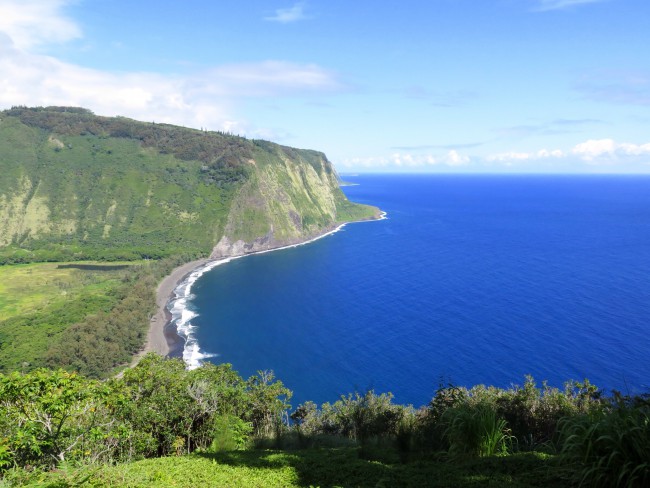
We left our hostel after breakfast and went north from Hilo to Waipi’o Valley, based on recommendations from people who told us it was the most beautiful beach on the Big Island. When we reached the valley, we parked our car at the top of the cliffs and got an amazing view of the valley and Waipi’o Beach. Although the beach is beautiful, it was at this time that I realised how lucky we are in Australia to have such stunning beaches (I need to appreciate them more back at home) and that I am also a bit of a beach snob. For me personally, I prefer white sandy beaches as oppose to black-sand, which is what I saw when looking over Waipi’o Beach.
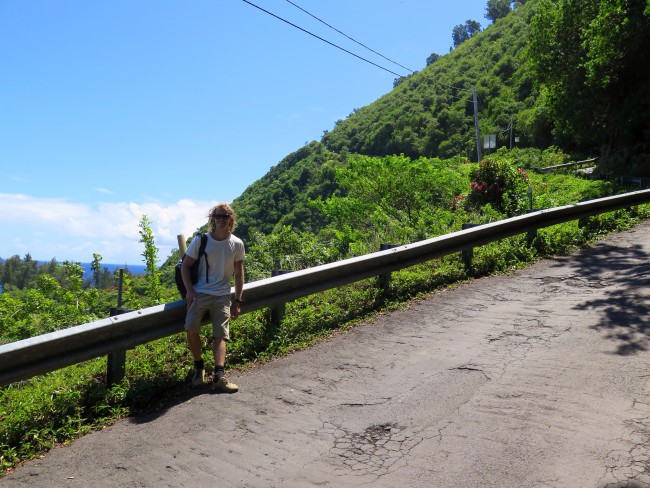
To get down to the beach you have to hike or drive a 4WD down an outrageously steep (25% grade) 1.6 km (1 mile) road that winds down the cliff. The walk down took us about 30 – 45 mins because I was getting pains in my knees attempting to stop myself from toppling down the hill. All I could think about was how unfit I was and how hard the walk back up was going to be! At the bottom of the hill we reached a fork in the road and turning right, walked another 10 mins (on an almost flat, sandy path) to the beach.

After we had chilled out for a couple of hours on the beach (Xave went for a swim although advised not to because of the strong current) it was time for the dreaded walk back up. We saw some people standing at the aforementioned fork in the road and had heard you can hitch back up the hill with one of the 4WD drivers. I’m not sure if it was my pride, stubbornness, impatience for waiting or just wanting to prove to myself that I do have some fitness levels, but I was determined to walk back up. OH MY GOD it was such a hard walk back up, not made any easier by how hot it was or by seeing the smiling faces of people we had seen at the fork, drive by in air-conditioned cars. After a lot of swearing, water and rest breaks we eventually made it to the top and were able to enjoy a nice picnic lunch at the lookout until we had cooled down.
The next stop off was going to be Waimea, which used to be cowboy country and today has Hawaii’s largest cattle ranch, Parker Ranch, which covers approx. 10% of the Big Island. On our way from the valley to Waimea, we picked up a hitch hiker and as soon as he got in the car I immediately wished we hadn’t and wanted to retract our offer. He looked like he was in his late teens and smelled strongly of cigarettes. He was sitting in the back with out bag that had our camera in it and I kept stealing glances from the front to make sure he wasn’t touching anything. The whole trip, Xave and I tried to start a conversation with him, but all we could get was one worded answers. Honestly, if you are a hitch hiker the least you could do is have some entertainment value because we weren’t asking for anything else! Needless to say it was quite an uncomfortable 30 mins and it was a huge relief when he got out of our car. Wanting to put as much space between us and the guy and not really seeng anything in town that caught our eye, we decided not to stop in Waimea and kept driving.
Taking saddle road, that cuts through the island back to Hilo, we stopped off at Mauna Kea, Hawaii’s highest peak at 4, 200 m (13, 796 ft). The terrain in this area is very different to the luscious green coastline near Hilo that we were driving past earlier. It’s a lot more barren and arid, sparsely populated with small, bushy shrubs. Driving up the mountain the temperature became noticably colder and a layer of fog began to cover the ground. By the time we arrived at the Onizuka Visitor Infomation Centre, 2, 800 m (9, 200 ft) elevation above sea level, we were freezing in our shorts and T-shirts. I didn’t realise but it snows up here in winter and you can actually ski (not the first activity I associated with Hawaii). Unfortunately for us to go to the summit you need a 4WD, which we didn’t have, so we were unable to go any further. I didn’t feel too bad about it though, because of the fog setting in, I wasn’t sure how good visibility would be up the top anyway.
The summit of Mauna Kea is a leading site for astronomical research worldwide. The University of Hawaii holds the lease to the Mauna Kea Science Reserve (practically the whole summit) and they were responsible for building the first telescope here 1968. They now lease out the area to others and there are currently 13 telescopes in operation. It was here in 1996 that one of the telescopes discovered the most distant galaxy ever observed in the Virgo constellation. It is thought to be 14 billion light years away!
Each night from 6-10pm the Visitor Information Centre offers a free star gazing program.
 Every Country