After a few hours in Panama City, it quickly became my third favourite city in Latin America (after Rio and Buenos Aires). If you are continuing your journey up through Central America, make the most of this city because the next best capital won’t be until Mexico City.
We stayed here for three nights but I could have done with a couple more. What I really like about Panama City; is the contrast between three different areas that all form the same city.
Panamá Viejo (Old Panama)
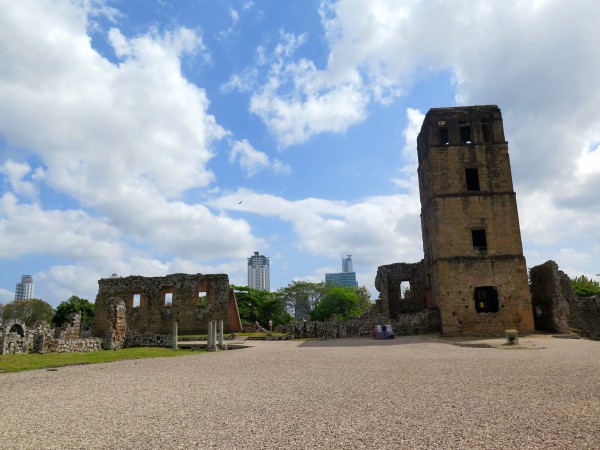
Spanish governor Pedro Arias de Ávila founded Panama City in 1519. Panamá Viejo was the original location of these first Spanish settlers who over the next 152 years, transformed the city into an important centre for politics and religion. However, this came to an abrupt end when Welsh pirate Henry Morgan (who later became the namesake for the Captain Morgan Rum Company) attacked and plundered the city, and left it destroyed by a fire.
Today, the ruins are a worthy visit, although some parts are overgrown with grass and weeds. For $7 USD, you will have entrance to the ruins and the Museo de Sitio Panamá Viejo (although I would have been happy to miss this after spending an hour walking around the ruin site). The area is quite large and has many examples of original buildings, although you will need to use your imagination more with some of them. The highlights are the cathedral and tower, which gives a good view over the whole area, the convent of Santo Domingo and the church of San José.
Casco Viejo (Old Quarter)
After the destruction of the former city, the Spanish moved Panama City 8km south-west to a peninsula that because of a surrounding reef was easier to defend. The prime time for this area was from when it was built in 1673 to the early 1900s during the construction on the Panama Canal. With the building of the canal came an influx of people from almost 50 different countries. This population growth, forced the city to expand its boundaries to where the current metropolitan area is now.
Today, Casco Viejo is a work in progress. It’s made up of a combination of crumbling, abandoned buildings and beautifully restored houses with Spanish and French influenced architecture. A favourite place with tourists to stay; this area is ideal for wandering the streets, eating out at the cafés, bars and restaurants and finding the perfect location to admire the modern city’s skyline. Whilst we were here we checked out:
- Plaza de la Independencia: the site where Panama, on the 3rd of November declared its independence from Colombia
- Teatro Nacional: built in 1907, we were hoping to go inside to see the supposedly magnificent restored interior, however after walking around the building a couple of times and talking to some guards, they told us it was closed until further notice.
- Paseo las Bóvedas: a pleasant walk along this esplanade gives sensational views of the city skyline, ocean, the Bridge of the Americas and the ships lining up to enter the canal. The best time for this stroll is around sunset. The esplanade leads to Plaza de Francia, a memorial site dedicated to the 22,000 workers who died while building the canal.
- Museo de Historia de Panamá: a somewhat interesting, small, free museum on Panama’s history.
- Mercado de Mariscos: for seafood lovers this is a must-visit. Straight after the fish have come off the boats, restauranteurs line up to get the daily delivery to cook it up. There are a number of possible eating options, so take a stroll to find which place takes your fancy (we usually judge a place on how busy it is, especially with locals) and the food is mostly reasonably priced. A specialty of the area is the $2.50 USD ceviche, which come in a variety of flavours.
- Tántalo Bar: the downstairs restaurant is good for lunch specials (the pulled pork sandwiches were delicious) and the rooftop bar is good for happy hour cocktails and sunsets.
- Café Coca Cola: established in 1875, this place claims to be the oldest café in Panama City and has fed many famous visitors including Che Guevara. This is a very local experience, from the sketchy street it’s on, the menu of overcooked meat, beans and rice and the old Panamanian men who visit it. Nice and cheap though!
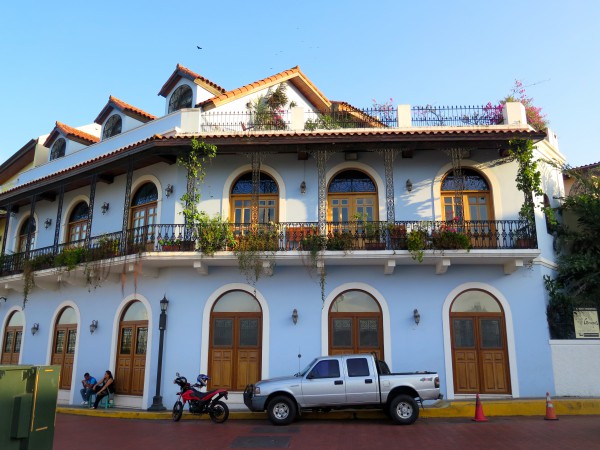
A colourful house in Casco Viejo
Panama City
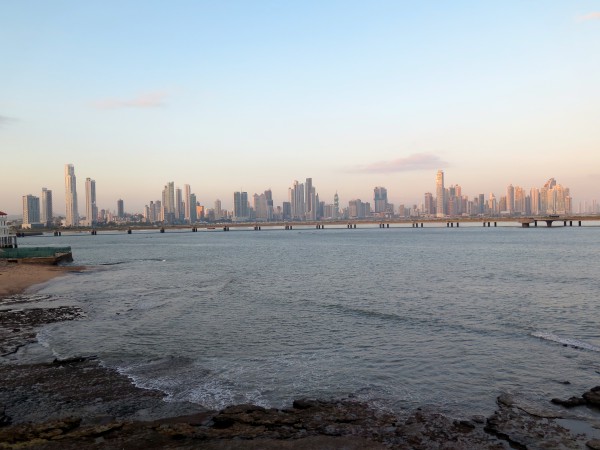
Apart from one night at a hostel in the El Cangrejo neighbourhood, we didn’t spend a lot of time in the urban centre of Panama City. That neighbourhood it particular was mostly residential so as a tourist there wasn’t anything appealing for us to see there. We ended up just racking up taxi fares trying to get to and from there. My favourite thing about the centre; was to view the skyline from a distance. The Causeway is one of the better places to see it from. A palm tree lined stretch of road, links four small islands to the mainland and is made up of rock excavated from the Panama Canal. It’s possible to enjoy the view while cycling, walking, skating or jogging along the Causeway’s designated path.
Not to be missed….
Probably the first thing you think of when someone mentions the words Panama City would have to be the Panama Canal. Personally, I can’t understand how people choose not to visit the canal if they are in the City anyway. I’m not an engineer, but I can still appreciate the construction of it, is an impressive feat.
The canal divides Panama in two, stretching 80km, it connects the Pacific Ocean with the Atlantic Ocean. There are three sets of double locks; Miraflores, Pedro Miguel and Gatún.
Building of the canal originally began in 1881 by a French company, but they later abandoned it due to financial and technological challenges. In 1901, an American company took over and completed the canal in 1914. Throughout this time around 27, 000 workers died from disease (yellow fever and malaria) and accidents.

The easiest and closest locks to reach from Panama City are Miraflores. We took a private shuttle with Hostel Ride ($8 USD return trip) but you can catch a local bus or taxi there as well. It costs $15 USD to enter the Miraflores Visitors Centre, which includes entrance into a fascinating four-story museum on the history of the canal and surrounding area, several observation platforms and a restaurant. Between 13,00-14,000 vessels take the 8-10 hour journey through the canal each year. Every vessel that travels through must pay a toll based on its size and cargo volume, with larger ones paying an average of $300,000-$400,000 USD. The smallest toll ever paid was $0.36 in 1928 by American adventurer, Richard Halliburton who swam through it. For the best chance of seeing a big liner going by; go between 9am-11am or 3pm-5pm.
Portobelo to Panama City: We caught a private shuttle, which was organised through our captains from Micamale, that took 2 hrs and cost $19 USD. I believe you can catch two public buses, changing in Colón/Sabanitas and costs roughly $3 USD.
Panama City to Santa Catalina: This was a long day, especially after a big night out! We started from Panama City’s main bus terminal, Albrook Bus Terminal, with an 8am bus to Santiago, (4 hrs, $9 USD). From Santiago, we caught a bus to Soná (1.5hrs) and then changed to another bus at around 2pm to Santa Catalina (1.5hrs, $5 USD). The last bus from Soná to Santa Catalina leaves at around 4pm, so make sure you make the connection, because you wouldn’t want to spend the night there.
 Every Country