In the south of Guatemala is the picturesque, volcano ringed Lake Atitlan (or Lago de Atitlán in Spanish) which is a must see when visiting the country (we spent four weeks here!). Surrounding the lake are small villages, each with their own personalities. Depending on what you’re into will probably determine where you will stay, however most villages can be used as a base from which to visit others. Boat trip around the lake are fairly regular and easy to catch although the annoying thing is they charge people different prices. Most trips around the lake are 10Q although locals only pay 5Q and if you are going to Pana from San Marcos or San Pedro it’s 20-25Q. Make sure you always have the correct amount of money so they don’t try to short change you. The villages that we visited were:
Panajachel (Pana)
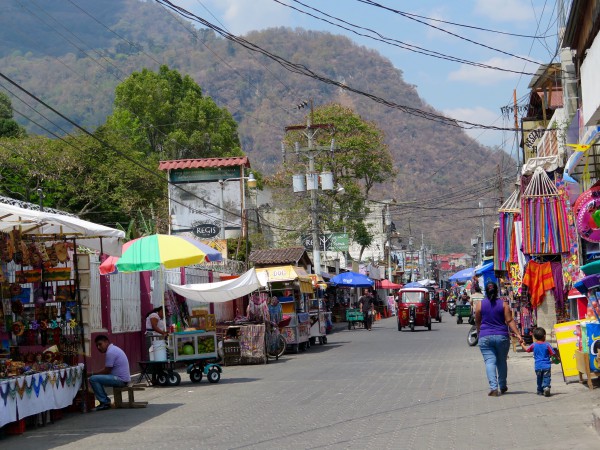
We arrived to the Lake via Pana and also went there on a day trip from San Marcos. The most built-up village on the lake it is a great place to go shopping and get necessities. The main street is lined with shops selling both traditional and factory made Mayan goodies (make sure you look carefully so you can tell the difference). There is also a nice variety of restaurants, bars and cafés in town to try out which was an exciting experience for us after eating similar food in our village for the last three weeks.
San Pedro
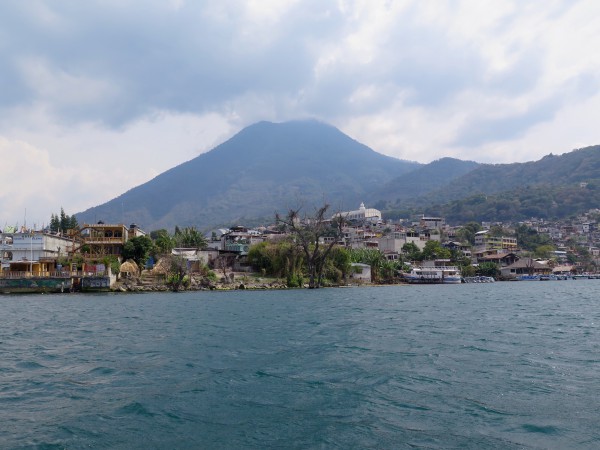
The party village! As soon as you get off the dock in San Pedro the first street you get to is the main gringo hangout. It is lined with so many bars and restaurants competing against each other on price that everything is quite affordable. The locals live further up the hill in the neighbourhoods surrounding the market. We stayed here for just under a week, which was probably a bit long for us however there a plenty of Spanish schools in the village if you are looking at doing something productive with your time. They all organise home stays with local families to not only help your Spanish but also gives a good look into the Mayan culture as well. Although our time in San Pedro was fun, it wasn’t as party-party as we thought. We went out to Sublime one of the more popular bars on a Saturday for our last night and they turned the music down to barely audible at 11pm but said everyone could stay till 1am when they would be closing!
San Marcos
San Marcos is an acquired taste. We were there for three weeks working at a hostel and while we thoroughly enjoyed our time there I can understand that it wouldn’t be for everyone. It is such a beautiful and relaxing however I just couldn’t stop thinking that the village has been overrun with expats, who now either live there full time or came for a week and now won’t leave. They have transformed the village into a place famous for its alternative lifestyles. The numerous community boards around town have signs promoting massage courses, lucid dreaming workshops, astronomy, guitar and yoga classes, cacao ceremonies, chanting and meditation circles, feminist menstrual cup discussion groups and spiritual sexual shamanism courses. Everything though is run by expats for expats and aside from Konojel (a nutrition centre providing free meals to residents) and hiring local staff in cooking and housekeeping roles it’s hard to see how everyone is giving back to the community they have taken over. Whilst we were there we went to a Mayan ceremony which involved sitting around the a fire, giving praise to the Mayan gods and offering up candles, seeds, spices and salts to the fire. The ceremony was performed by two native Mayan people and one white English guy who really ruined the authentic feel to it. I also went to see Ben the palm reader who lives in the house behind the elephant head gateway above 2012 (yes these are actual directions I received when enquiring of his whereabouts). I have never been to one before and I found it quite interesting. While some of the things were a bit far fetched (from looking at the back of my hands face down, he said I was becoming more independent because the gap between my pinky finger and ring finger is slightly bigger that the gaps in between my other fingers) other things were scarily accurate. I found he didn’t tell me anything that I didn’t already know, but it’s a bit freaky when a complete stranger who I had never met before knows so much about me just from looking at my hands.
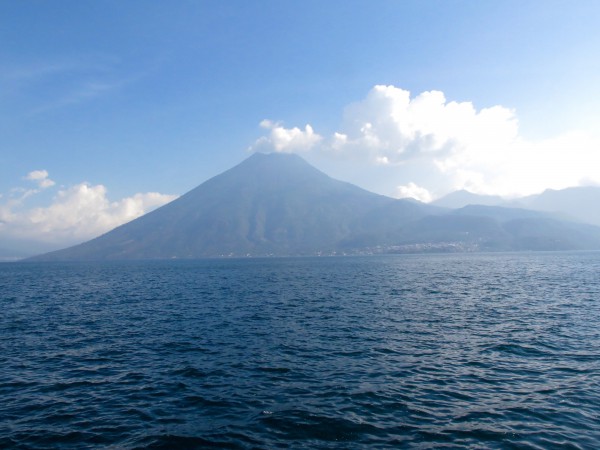
The main tourist ‘town’ of San Marcos is made up of a rabbit warren of paths weaving in all directions which for the first couple of weeks I was convinced were like the staircases at Hogwarts, constantly changing where they lead you! After the main road the rest of San Marcos winds up the hill into neighbourhoods. If you can find them some good places for food, coffee and accommodation are; Del Largo (great hostel on a budget and big plates of delicious food), Lush (higher end accommodation with a great restaurant), the Yoga Forest (permaculture and yoga retreats), Restaurant Fe (specialising in curry), Circles Café, Posada Schumman and Shambhala Café. Although there are a couple of expats offering Spanish classes we wanted to find a local teacher to support and whose first language is Spanish. Luckily we didn’t have to search too hard for Francisco, a great teacher, who along with teaching us our Spanish verbs was full of stories about growing up in Guatemala around the lake.
Jaibalito
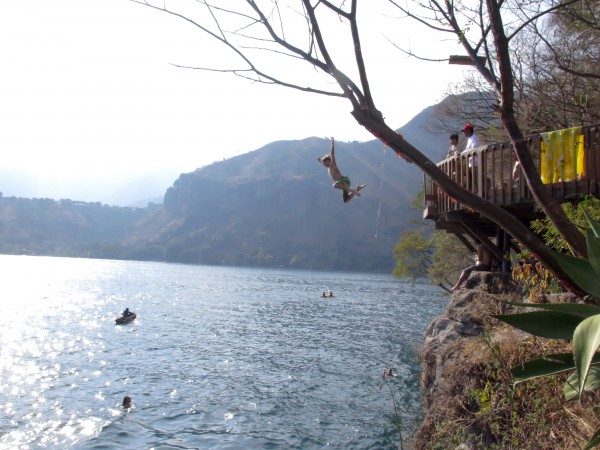
Two villages around from San Marcos is Jaibalito, a very small and quite village that can be accessed by foot or boat. Our main reason for visiting was to track down a German restaurant, called Posada Jaibalito run by Hans. After asking some locals, we eventually found it and aside from a couple of German dishes on the menu, you would not be able to guess it was German run from the outside. The restaurant is located in a garden, where ducks, roosters, cats and dogs are roaming around. The local ladies in the kitchen are fairly relaxed so don’t go there if you are in a hurry. The food is worth the wait though and is great value for money. After lunch when searching for a coffee we stumbled on Club Ven Acá which couldn’t be anymore opposite from where we had just been. Right on the lake with an infinity pool from which to enjoy the view, this beautiful restaurant and hotel has a strong Spanish feel to it. Whilst the menu looked great it had a higher end price list to match in comparison to the rest of the lake. Despite this we thought the three girls lounging by the pool sharing an antipasto plate, bottle of tequilla and fresh jug of juice to mix had the right idea!
Tzununá
Situated in between San Marcos and Jaibalito, Tzununá seems to be where expats who think San Marcos house prices are too higher are moving. There isn’t a lot going on here except for Atitlan Organics, a permaculture farm ran by Shad and his wife Colleen. High up the mountain, their property has stunning views of the lake and a garden filled with vegetables, edible plants and wandering goats. They run courses and retreats to teach others how to be self-sufficient and make money from permaculture farms and growing your own produce.
Antigua to Lake Atitlan: Originally the plan was to catch a chicken bus from Antigua to Chimaltenango change and then catch another one to Pana, however we ran into a tour group who were heading the same way and decided to tag along. Sometimes it’s nice to stop thinking about logistics and let someone else do the work because we assumed the leader would know the way. It wasn’t until our third chicken bus that we realised the leader was from Mexico and had only made this journey a couple of times. We got there in the end but it took four buses; changing at Chimaltenango, Los Encuentros and Sololá (I think), four hours and cost about 50Q. I don’t recommend this! From Pana we then caught a boat for 25Q to San Pedro.
Lake Atitlan to Antigua: After the trouble of getting to the lake we decided to give the chicken buses a miss and catch our first shuttle in Central America instead. Booked from a travel agency in San Marcos, it cost 80Q, they picked us up from the town centre and it took just over two hours. The whole process was a lot simpler and easier and cost roughly the same price!
 Every Country